




Registration Open! SJTU International Summer School on Data-Driven Decision Making 2026-06-17
2026 International Summer School on Data-Driven Decision Making
Hosted by the Society of Management Science and Engineering
Co-organized by Antai College of Economics and Management, Shanghai Jiao Tong University
About the Program
To spark student research interest and enhance skills in big data analytics, the Society of Management Science and Engineering, in collaboration with Antai College of Economics and Management at Shanghai Jiao Tong University (SJTU), jointly presents the 2026 International Summer School on Data-Driven Decision Making. The series of lectures, scheduled July 2026, focuses on frontiers in data elements and intelligent decision-making.
Target Audience
The program is primarily designed for undergraduate students, master's students, and doctoral students in related fields.
Topics
• Big Data Analytics
• Machine Learning
• Consumer Behavior Analysis
• Artificial Intelligence
• Business Decisions
Program Schedule
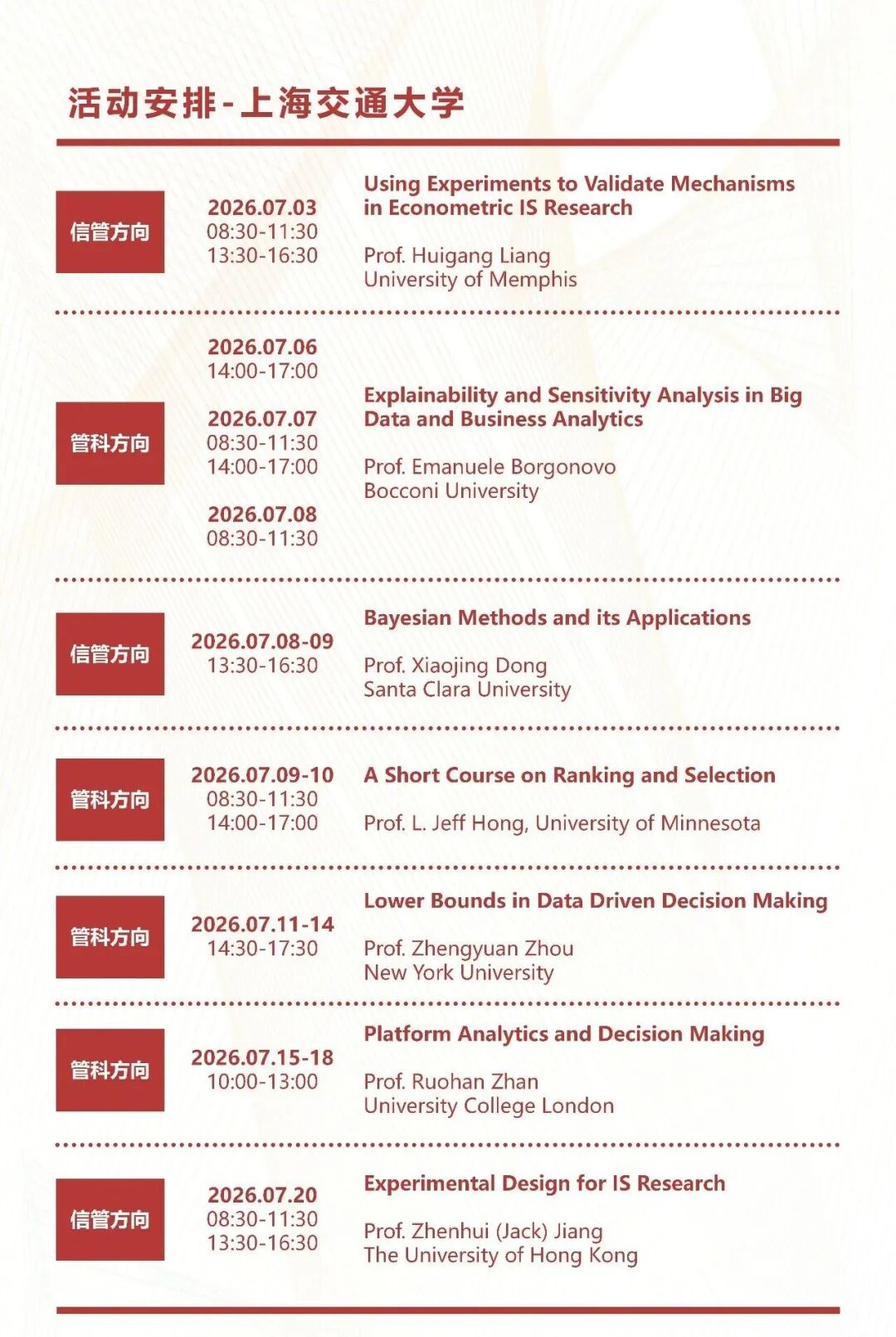
Registration and Participation
This is an in-person program, free of charge. Accommodation is not provided. All costs related to transportation and lodging are to be borne by participants themselves. Please scan the QR code below to complete registration. Registration confirmation, venue details, timing, and additional notes will be sent to the email address you provide. Please ensure your email is correct, and do not register more than once.

Venue: SJTU Xuhui Campus, Shanghai.
Course Descriptions
Management Science Track
01 Explainability and Sensitivity Analysis in Data-Driven Decision Making
Speaker: Prof. Emanuele Borgonovo (Bocconi University)

Time: July 6, 14:00–17:00 | July 7, 08:30–11:30 & 14:00–17:00 | July 8, 08:30–11:30
Brief introduction of the content:
Researchers, private entities, and public organizations are increasingly turning to mathematical models—machine learning algorithms, artificial intelligence tools, and computer simulators—to inform decision-making. As concerns about explainability, interpretability, and responsible AI continue to grow, there is a pressing need for tools that clarify input–output relationships and ensure robust, transparent, and interpretable results. This course introduces students to modern tools for explainability, interpretability, and sensitivity analysis in computer experiments, simulation models, and machine learning. It connects classical decision-analytic sensitivity methods with global sensitivity analysis and post-hoc explainability techniques for artificial intelligence. Students will learn how to analyze input–output relationships, assess robustness, identify important variables, and interpret black-box models using tools such as finite-change indices, variance-based measures, moment-independent indices, optimal-transport methods, permutation importance, and Shapley values. The course emphasizes intuition, theoretical foundations, and applications to deterministic simulations, stochastic models, and machine-learning systems. The exposition will be complemented by computer-based exercises, allowing students to gain hands-on experience with the techniques discussed in class.
02 A Short Course on Ranking and Selection
Speaker: Prof. L. Jeff Hong (University of Minnesota)

Time: July 9–10, 08:30–11:30 & 14:00–17:00
Brief introduction of the content:
This short course provides an introduction to ranking and selection (R&S), a simulation optimization methodology for identifying the best system or decision alternative under uncertainty. The course covers the two fundamental formulations of R&S, including fixed-precision procedures and fixed-budget procedures, together with their statistical foundations and practical implementations. We will also discuss modern challenges arising in large-scale simulation optimization, as well as recent developments in robust R&S and contextual R&S, where decisions adapt to uncertainty and contextual information. The course is intended for graduate students, researchers, and practitioners interested in simulation, stochastic optimization, and data-driven decision making.
03 Lower Bounds in Data-Driven Decision Making
Speaker: Prof. Zhengyuan Zhou (New York University)

Time: July 11–14, 14:30–17:30
Brief introduction of the content:
A potent tool that has long been utilized in statistics for establishing fundamental limits in estimation problems, Le Cam's method provides an elegant framework for establishing the fundamental difficulty of learning by reducing it to binary hypothesis testing, where the learner cannot distinguish between two constructed environments sufficiently well. Here, we bring this toolkit to the attention of these communities and demonstrate its versatility across a range of such data-driven decision-making problems, either online where data arrives sequentially or offline where data has been collected into a single batch. We present several applications—by no means exhaustive but hopefully representative of the richness in the problem landscape and hence a reflection of this
method's power—where lower bounds are established on the data efficiency metrics: regret when the problem is online and sample complexity when the problem is offline. Through these examples, we delineate a unified blueprint for constructing indistinguishable problem instances with separated optimal decisions, offering a principled approach to quantifying regret and sample complexity lower bounds using Le Cam, which offers an analytical template that can guide future lower bound constructions in problems of a similar nature.
04 Platform Analytics and Decision Making
Speaker: Prof. Ruohan Zhan (University College London)

Time: July 15–18, 10:00–13:00
Brief introduction of the content:
This course examines how digital platforms make data-driven decisions, and the methodological tools required to study those decisions honestly. We focus on four canonical platform problems and the techniques that have emerged to address them: two-sided marketplaces, where causal entanglement between sides motivates experimental design under interference and structured estimation; personalization and targeting, where heterogeneous treatment effects, policy learning, and off-policy evaluation guide who to treat and how; long-term optimization, where surrogate indices and reinforcement learning inference bridge short-term signals and long-horizon outcomes; and digital pricing, where double machine learning, demand modeling, and multi-product optimization handle endogeneity and substitution. Throughout, we will also examine how the rise of recent technology is reshaping both the data-generating process and the decision space these methods are designed for.
Information Management Track
01 Using Experiments to Validate Mechanisms in Econometric IS Research
Speaker: Prof. Huigang Liang (University of Memphis)

Time: July 3, 08:30–11:30 & 13:30–16:30
Brief introduction of the content:
This tutorial introduces IS PhD students to integrating econometric and experimental methods in information systems research. Econometric studies offer strong external validity and causal identification using archival or platform data but often struggle to uncover behavioral mechanisms. Experiments provide stronger control and mechanism testing but may lack real-world realism. By combining these approaches, researchers can strengthen causal inference, improve theory development, and increase publication potential in top IS journals. Using examples from digital platforms and online user behavior, the tutorial shows how experiments can validate mechanisms identified in econometric analyses. It also offers practical guidance on research design sequencing, hypothesis development, data integration, and common methodological pitfalls for emerging IS scholars.
02 Bayesian Methods and Its Applications
Speaker: Prof. Xiaojing Dong (Santa Clara University)

Time: July 8–9, 13:30–16:30
Brief introduction of the content:
Bayesian statistics has transformed empirical modeling by offering powerful tools for estimating complex models that are often difficult to handle using traditional frequentist methods. This course introduces graduate students to the core principles of Bayesian inference, emphasizing both theoretical foundations and practical implementation. Through applications to real-world data on human decisions and behavior, students will learn how to formulate, estimate, and interpret Bayesian models using modern computational techniques.
03 Experimental Design for IS Research
Speaker: Prof. Zhenhui (Jack) Jiang (The University of Hong Kong)

Time: July 20, 08:30–11:30 & 13:30–16:30
Brief introduction of the content:
The seminar will focus on the use of experiments, including lab and field experiments, for studying user behavior. In particular, we will cover critical issues used to evaluate the appropriateness of methods, including validity, reliability, levels of analysis, statistical power, and significance testing. We will also discuss some exemplar papers to deepen our understanding of the methods.
Contact Us
Shanghai Jiao Tong University:
• Management Science: yuxin.su@sjtu.edu.cn
• Information Management: sjtuwanghaiqing@sjtu.edu.cn
We look forward to your participation!